







If you’re currently part of the North American Language and Culture Assistants Program, better known as NALCAP, and you’re thinking about staying another year in Spain, the good news is that renewing is pretty doable. The key thing to know, though, is that renewal is not automatic. You do have to apply again.
There is also a priority system used when assigning placements. In general, placements are given based on your application number (inscrita number) and a certain order. Previously, changing regions often placed renewals on relatively equal footing with first-year applicants. That is no longer the case. The new placement priority order is:
1) First-year renewals staying in the same region
2) First-year renewals changing regions
3) New applicants
4) Second-year renewals
5) Third-year renewals
This means that newer applicants may now receive priority over some returning auxiliares depending on their renewal year and regional request.
Your inscrita number is essentially the number assigned to your application when it is submitted. In simple terms, it reflects the order in which applications are received. For example, if your number is 743, that means you were roughly the 743rd applicant to submit. If it’s 1206, you were around the 1,206th applicant. Typically, this numbering system starts at zero at the beginning of each application cycle and increases as more people apply.
However, during the 2025 application cycle, many applicants noticed something unusual. Instead of restarting at zero, the numbering appeared to continue from the previous year’s final applicant. Because of this, the first numbers people saw were already around 12,000, which led us to believe there may have been a glitch or carryover in the system.
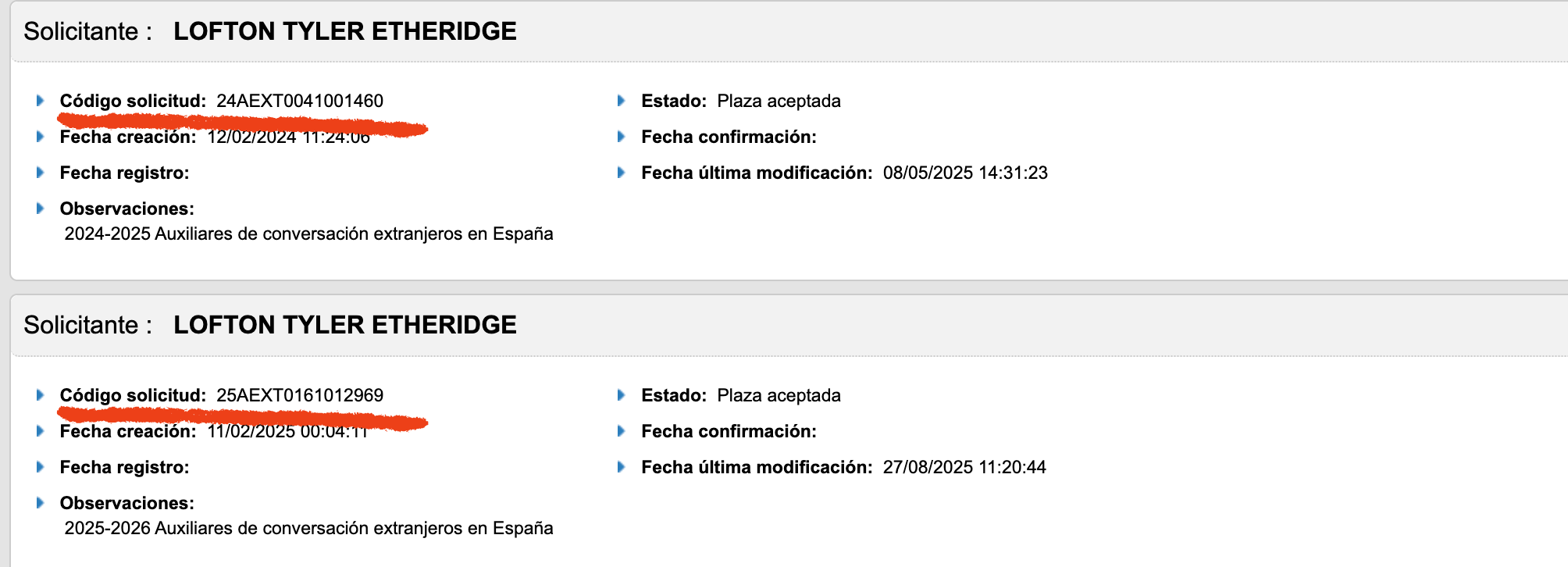
Regardless of where the number begins, the important thing to understand is that the inscrita number simply represents your place in the application queue. You can find this number in your application under the label “Código solicitud.” This is the official identifier associated with your submission and is what people commonly refer to as their inscrita number when discussing application order.
To find your inscrita number, you simply need to look at the last few digits of your registration number. Typically, you’ll focus on the last 1 to 5 digits, depending on how high or low your number is in the system.
For example, during my first year in the program, my inscrita number was 1,460. The following year, my number appeared much higher at 12,969. Again, the numbering system didn’t reset, and 12,000 (more or less) effectively became the new starting point.
In other words, the earlier you apply, the better your chances are. Renewals also have a bit of flexibility. You can either:
- Renew at the same school
- Or submit a renewal application and try somewhere new
But just like the original application, you’re never guaranteed a specific city, region, or location. That part always has a bit of mystery to it. The renewal window usually opens in early February and runs through March, so it’s important to stay on top of the timeline.
In total, auxiliares are allowed to participate in up to four school years in the program. However, many regions set their own limits, so make sure to read the specific conditions for the region you’re applying to before submitting your application.
And just to clarify something that confuses a lot of people:
- If you are applying to NALCAP for the first time, you’re considered a first-year applicant.
- If you are applying for your second, third, or fourth consecutive year, you are considered a renewal.
- However, if you completed a couple of years in the program, went home, joined another program, or took time off and then applied again later, you are considered a first-year applicant again.
Spain loves a technicality.
There’s also something important to be aware of regarding visas. With the immigration law that went into effect in May 2025, it is no longer possible to simply modify certain visas from inside Spain. For example, programs like the BEDA program operate under a higher studies visa, while NALCAP uses its own student visa category. Because of that, switching between those two programs may require returning to your home country to apply for the correct visa.
If you’re thinking about doing NALCAP, here’s an important thing to keep in mind if you’re switching programs. If you’re currently participating through programs like Fulbright or ConversaSpain, you will be considered a new applicant when applying for NALCAP.
However, if you’re coming from RVF, you are not typically considered a new applicant and may be treated differently in the application process. **That said, immigration rules in Spain can change quickly, so it’s always best to double-check the latest information or speak with a legal professional before making decisions.**
Now that we’ve covered the basics, let’s walk through the renewal process step by step.
Step 1: Talk to Your Coordinator First
Before you even open an application, start by having a conversation with your coordinator or director at your school. Let them know that you’d like to renew in the program. During that conversation, you should also tell them whether you want to:
- Stay at your current school
- Move to a different school or region
If your school has been happy with your work, they’ll complete an informe (your school evaluation report) and give you a favorable review. You need to print out the informe and take it to your school director so they can complete, sign, and stamp it. Make sure they mark “sí” for the question “¿Recomienda la renovación en el programa?” If it says “no,” you won’t be eligible to renew.
Once your director gives it back to you, you’ll need to upload it and submit it through PROFEX 2. If you want to stay at the same school, they can also request you directly on their end, which increases the chances of staying there another year. Your coordinator may also ask for your Profex 2 application number so they can complete their part of the renewal request.
***The best app I’ve used for scanning and uploading documents is CamScanner. Simply scan the document(s) using the app and email them to yourself (for example, to your Gmail account). Then open the email, download the files, or save them directly to Google Drive. When you upload additional documents to PROFEX 2, just select them from your computer’s Downloads folder or from your Google Drive.
Step 2: Prepare Your PROFEX 2 Application
Next comes the platform portion of the process. You’ll need to complete your application through PROFEX 2, which is the updated system used for applications and renewals. If you want a full breakdown of the process, the Ministry has an official guide that walks through every section of the application step by step. Renewal Manual (2025–2026). It explains how to navigate the platform and make sure everything is submitted correctly.
Step 3: Update Your Passport Information (If Needed)
Your passport must now be valid throughout your entire stay! In previous years, applicants could apply with a passport that was set to expire soon, renew it later, and then update their information afterward. That is no longer allowed. If your passport expires before or during your stay, your application may be skipped or considered ineligible entirely. Do not wait until after applying to renew your passport.
For example, visas are now typically issued for a full year. So if your program starts in October, your visa will usually be valid from September of that year through September of the following year. Because of this, your passport generally needs to have at least one year of validity in order for the visa to be issued.
If you input your information incorrectly, you should be able to reach out to any of these contacts for support. You can contact (miguel.gonzalezs@educacion.gob.es) and send a photo of your new passport as proof. If that email isn’t responsive, try contacting support at (profex.soporte@educacion.gob.es), and lastly, if needed, you can also contact the NALCAP program directly at (auxiliares.extra@educacion.gob.es)
To update your passport details, follow these steps in the PROFEX 2 portal:
- Log in to PROFEX 2 and go to My Profile. Then navigate to: General Data → Basic Data → Modify → Change Document Number.
- Enter your new passport number and click Save.
- Upload a scanned copy of your new passport as a PDF in the “Attached Documents” section of PROFEX 2.
- Email (auxiliares.extra@educacion.gob.es) to let them know you’ve updated your details.
- Wait for confirmation that your passport number has been successfully updated, along with any further instructions from the program team or technical support.
Keep in mind that your PROFEX 2 username is your passport number, so it’s very important to keep it updated. This ensures you can still access the platform properly and avoid issues related to visas or your TIE.
Step 4: Submit Your Application and Watch Your Email
Once you finish your application in PROFEX 2, you’ll be able to download a PDF copy of the submission. This document includes your inscription number (your Profex number), which you may need to give to your coordinator. After submitting, keep an eye on your email. NALCAP will send updates about:
- Application status changes
- Missing documents
- Corrections you may need to make
Check your spam folder too, because sometimes their emails end up there.
Step 5: Confirm Your School’s Renewal Request
If you’re renewing with the same school, you may receive a notification through your auxiliares portal once your school submits their request. When that happens, you simply confirm the request, and your application moves forward in the review process. If anything needs to be corrected, PROFEX 2 will notify you and give you instructions on how to fix it.
Step 6: Accept Your Placement
Once your (regional) placement is assigned, you’ll receive a notification through PROFEX 2. Important detail: you usually have three days to accept your placement. Yes, it’s the same system as when you first applied.
After accepting, your status will change to “Plaza aceptada.” Soon after, you’ll receive your Carta de Nombramiento, which is the official school placement letter you’ll need for immigration and residency paperwork. -> Guide to How to Accept or Decline Placement in Profex 2
Step 7: Don’t Forget Your TIE or Visa
Finally, there’s the immigration side of things. To remain in the program, you’ll need to either:
- Renew your TIE if this is your first renewal inside Spain
- Or apply for a new visa from your home country over the summer
Both options are valid. That said, renewing your TIE inside Spain is usually much easier than starting the visa process all over again. And if you’ve already gone through the visa process once, you probably remember exactly why. And remember, with the new law that went into effect in May 2025, you are only allowed to renew your TIE card once, so after your second year in the program, you will more than likely have to go back home for a whole new visa for your third year. If you’re renewing your TIE -> TIE Renewal: (Prórroga de Estancia por Estudios) — Step-by-Step Guide
‼️ NALCAP RENEWALS MOVING FORWARD (AS OF 2026)
Here are some major updates and changes to the program that applicants and renewals need to be aware of (as of 2026). Please make sure to double-check everything on the official NALCAP Website because policies can change quickly and sometimes with very little notice.
- The new maximum age limit is 44.
- The maximum number of years in the program is now 4 years total. This has officially been reduced from 5 years. Realistically, many auxiliares were already finding it difficult to receive placements beyond 3 years, depending on region availability, but now the official cap has changed as well.
- TIE renewal (“prórroga”) rules have changed. If you received a brand-new visa since the May 2025 changes, you may be eligible to remain in Spain over the summer and renew your TIE through the prórroga process instead of returning home for a new visa. Remember, you can only renew your TIE once. However, you must submit your prórroga application before your current TIE expires. Be prepared because the process can be frustrating. It requires a digital certificate (DigiCert), is completed almost entirely through the Mercurio online platform, and many applicants, especially Mac users, report technical problems throughout the process.
- If you resigned from or left the program early, you may not be eligible to renew. Leaving your placement before completing your school year can impact your ability to participate again in future cycles of the program.
Overall, the program has become much more competitive and policy-heavy over the last few years, so staying organized and informed is more important than ever. Things that worked for previous auxes may no longer apply now, which is why it’s essential to rely on updated official information rather than older blog posts, TikToks, or Facebook group advice alone.
Once you understand the steps, renewing your spot in NALCAP is actually pretty manageable. Most of it comes down to staying organized, communicating with your school, and keeping an eye on your email for updates. If you start early and keep track of the deadlines, the process can be surprisingly smooth. And then you get to spend another year living in Spain, which is really the whole reason we’re all doing this in the first place.
Love always,
American Girl Meets World


