







One of the questions people ask me all the time about being an auxiliar is, “What does a normal day actually look like?” And honestly, the answer is… it depends. Every school builds your schedule around their needs, so no two assistants will have the exact same timetable. Some people work four days a week, some five. Some start earlier, some later. But to give you a realistic idea, I’ll walk you through what my days looked like during my two years in Spain as part of the North American Language and Culture Assistants Program. (NALCAP)
My First-Year Schedule
During my first year, I was lucky enough to have Fridays off, which meant I worked Monday through Thursday. Most days were pretty short compared to a typical full-time job in the U.S. My schedule usually ran from 9:00 AM until 12:30 PM. A typical morning looked like this, with each class up to 45 minutes.
9:00 – 11:15 AM: Classes
I would usually help with a few different English classes during this time. My role here was to prepare a warm-up activity for the class for the first 10-15 minutes of the class. The main teacher then took over and taught from the book. As an auxiliar, your role is more about supporting the teacher and encouraging students to speak English, rather than running the whole class yourself.
11:15 – 11:45 AM: Patio (Recess)
Then came one of the best parts of the day: patio. Patio is basically recess, but everyone gets a break, including the teachers and assistants. Students run outside, and teachers head to the staff room or courtyard. For us, it’s basically snack time. If you bring something from home, this is when you eat it. It’s also a great time to chat with teachers or just relax for a bit.
11:45 AM – 12:30 PM: Final Class
After patio, I would usually have one more class before finishing the day at 12:30 PM. There was one day a week (Tuesdays) when I stayed slightly longer until 1:15 PM, but that day came with its own little adventure. My school was in a small pueblo, and the last bus leaving the town was at 1:10 PM. So if I finished at 1:15, you can probably guess what happened; I missed the bus every time.
So on those days, I ended up staying at the school until 3:30 PM, when I could ride back to town with the school psychologist, who happened to live in the same town as me. It actually worked out fine, though. I would usually bring a book or my computer and just hang out in the teachers’ lounge until it was time to go. Not exactly the plan, but you learn to roll with things when you live in a small town.
My Second-Year Schedule
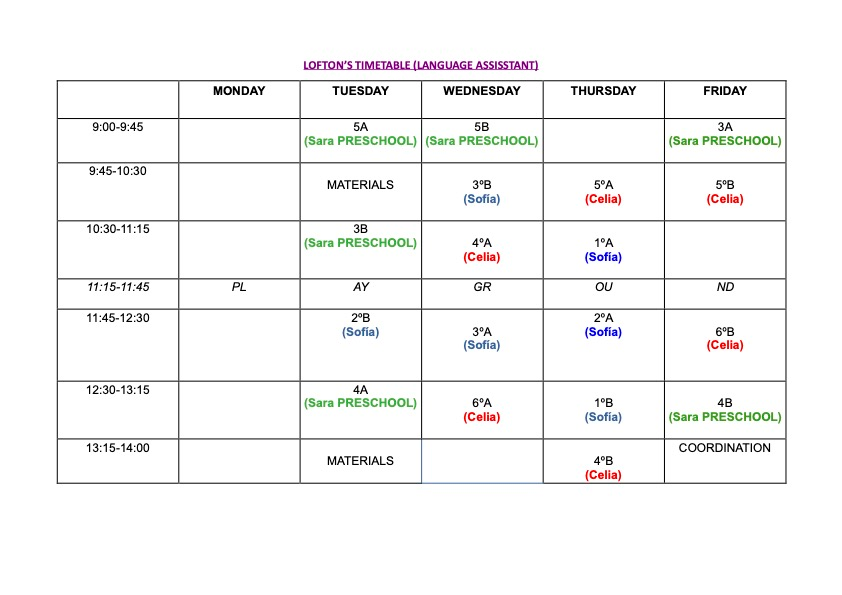
My schedule changed during my second year. Instead of Fridays off, I had Mondays off, so I worked Tuesday through Friday. Classes still started at 9:00 AM, and most mornings followed a similar rhythm.
9:00 – 11:15 AM: Classes
Again, this block was usually filled with a few different English classes. Depending on the day, I might rotate between different grade levels or classrooms.
11:15 – 11:45 AM: Patio (Recess)
Same patio break, same snack time, same moment to breathe before the last part of the day.
11:45 AM – 1:15 PM: More Classes
After the break, I usually had classes until 1:15 PM, which made my second-year schedule slightly longer than my first. There was also one day (Thursday) when things started a little later. Instead of beginning at 9:00, my first class was at 9:45 AM, but that meant my last class finished at 2:00 PM, which ended up being my latest day of the week. See the timetable below.
What Auxiliars Actually Do in Class
Another thing people are curious about is what assistants actually do during lessons. Most of the time, you’re there to help the teacher with things like:
- Leading conversation practice
- Helping students with pronunciation
- Running small group activities
- Playing language games
- Sharing aspects of your culture
Sometimes you might lead a short activity or presentation, but you’re usually working alongside the main teacher, not replacing them. And the atmosphere is usually pretty relaxed compared to a traditional teaching job. One thing that’s also helpful to understand about an auxiliar schedule is that sometimes you might have “free periods.” It might be 45 minutes, or it might be 2 hours. But you can do whatever you want during this time. You could leave the school and go to a nearby cafe, but only if you make it back before your next class.
You might see something called “Materials” on your schedule. This is the time that’s meant for preparing activities, games, presentations, or worksheets for upcoming classes. If you’re planning to do a speaking game with students or create a small presentation about your culture, this is when you’d put those materials together.
You might also have something labeled “Coordination.” That period is meant for meeting with your teachers. During coordination time, you can talk about upcoming lessons, plan activities together, or discuss how they want you to help in future classes.
In reality, these periods often end up feeling like free time, especially once you get into a rhythm and already have your materials prepared. But technically, they’re there for planning and collaboration. So your schedule might look something like this: you start with a class in the morning, then have a materials period, then another class, followed by coordination, and then another class later in the day.
Every Schedule Is Different
The biggest thing to remember is that every auxiliar schedule looks different. Your hours depend on:
- Your school
- The region you’re placed in
- The needs of the English department
- The age group of the students
Some assistants work mornings only, while others might have slightly longer days. Some people work four days a week, others five. So while my schedule might give you an idea of what a typical day can look like, your experience may be completely different.
The Best Part of the Schedule
One of the biggest perks of being an auxiliar is simply how much free time you have. Most days, you’re done by early afternoon, which leaves plenty of time to:
- Explore your city
- Study Spanish
- Travel
- Work on personal projects
- Or just enjoy life in Spain
And honestly, that balance is one of the best parts of the experience. You get to be part of a school community while still having the freedom to explore a completely new country. Not a bad way to spend a year… or two!
Love always,
American Girl Meets World


